

Mapping long-range projections at single neuron resolution at high throughput using BARseq and MAPseq
Type: Molecular / Cellular,
Type: Other,
Keywords: Molecular Barcode, Cellular Barcoding and Sequencing, Long-Range Projections, Single-Cell, In situ transcriptomics, Projections in rare species,Mapping Method, High Throughput
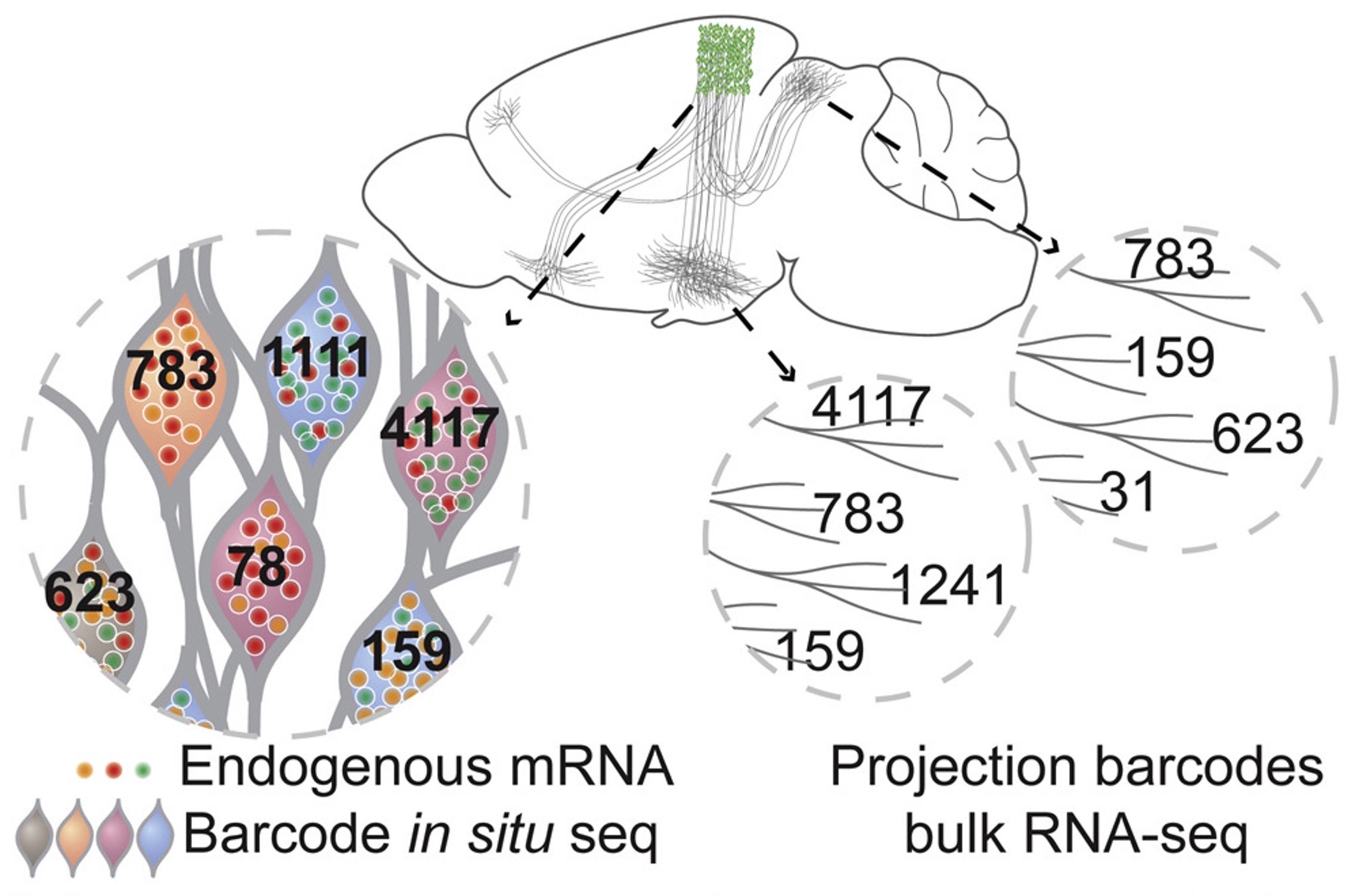
Mapping long-range projections at single neuron resolution at high throughput using BARseq and MAPseq
BARseq and MAPseq are high-throughput neuronal circuit-mapping technologies that can profile the long-range projections of tens of thousands of neurons from a single brain region at single-neuron resolution. By combining cellular barcoding with sequencing, these methods enable dense projection mapping and can link projection patterns with gene expression and Cre-defined cell identity. Their scalability makes it possible to compare circuit organization across neuronal subtypes, individual animals, experimental conditions, and genotypes. Through the CSHL MAPseq/BARseq Core Facility, we provide MAPseq as a service, consider BARseq projects based on experimental needs, and support laboratories interested in adopting either method independently, making these tools broadly accessible to the neuroscience community.
* MAPseq, a multiplexed barcode-assisted neuronal projection mapping method using next-generation sequencing.
* MAPseq labels each neuron with a unique molecular barcode that travels down the axon.
* BARseq, the next generation of MAPseq – a method for efficient and accurate sequencing of cellular barcodes and genes in situ.
* BARseq, in which barcodes/genes are sequenced in intact brain slices, preserves anatomical information and allows scientists to examine connectivity at greater resolution.
* BARseq allows researchers to map multiple measures in the same neurons: the barcodes, neuron activity and gene-expression data.
* BARseq and MAPseq have been successfully applied in multiple species, including singing mice, macaque and marmoset.
* Quantify the projections of thousands—or even millions—of individual neurons in parallel within a single brain.
* Produce multiple projection patterns from one to several injection sites, at single-neuron resolution.
* Determine the brain-wide projections from a given area.
* Compare projection patterns originating from different areas of the brain.
* Determine whether individual neurons from a given area project to a specific area of interest.
* Perform single-neuron tracing in less common animal model systems, including rodents and potentially non-human primates.
* Sequence cellular barcodes in intact brain slices, preserve anatomical information and examine connectivity at greater resolution.
* Map multiple measures in the same neurons: the connections, neuron activity via calcium imaging, and gene-expression data.
* Expand the brain map by accurately pinpointing the location of a neuron.
* Be potentially used for barcode-assisted lineage tracing, and map long-range axonal projections.
* Map long-range projections at single cell level in rare species.
* Mapped the connections of 3,579 neurons in the auditory cortex of the mouse brain.
* BARseq analyzed 10.3 million cells in the mouse forebrain, revealing that peripheral inputs shape area-specific genetic identities.
* MAPseq and BARseq profiled the gene expression of 1.5 million marmoset neurons and jointly measured gene expression and cortical projections in 708 marmoset and 1,518 mouse neurons that spanned multiple thalamic nuclei.
Mouse, Rat, Singing mice, Macaque, Marmoset
* Less expensive.
* High throughput.
* Less labor-intensive.
* Less time-consuming.
* BARseq allows researchers to tag and sequence the neurons in situ, or in their original form and location on the brain.
* Can pinpoint exactly where a neural connection begins.
* In situ bar-code sequencing would potentially allow visualization of the morphology of individual neurons.
* Preserving the locations of the cells being sequenced would allow correlation of lineages and projections with other information, such as gene expression assayed through FISH or in situ sequencing, and neuronal activities assayed through functional imaging, at cellular resolution.
* The approach is efficient, labeling thousands of neurons in a single experiment.
* BARseq employs the same sequencing reaction and reagents as Illumina sequencing machines, a popular commercial sequencing technology. But the reaction is done in a brain slice under a microscope.
* MAPSeq requires scientists to remove and analyze segments of brain tissue, destroying fine scale detail.
* BARseq can only provide a close estimate of where a neural connection ends.
* Do not have enough spatial resolution at the destination.
* Kebschull et al 2016 High-Throughput Mapping of Single-Neuron Projections by Sequencing of Barcoded RNA. Neuron 91(5)975-987.
* Han et al. 2018, The logic of single-cell projections from visual cortex, Nature 556: 51–56.
* Chen et al. 2019, High-throughput mapping of long-range neuronal projection using in situ sequencing. Cell. 179(3), 772-786.
* Sun et al. 2020, Integrating barcoded neuroanatomy with spatial transcriptional profiling enables identification of gene correlates of projections. Nat Neurosci. 2021 Jun;24(6):873-885.
* Chen Y, et al. 2022. Highthroughput sequencing of single neuron projections reveals spatial organization in the olfactory cortex. Cell. 2022 185(22):4117-4134.e28.
* Yuan et al. 2024. Massive Multiplexing of Spatially Resolved Single Neuron Projections with Axonal BARseq. Nat Commun 15, 8371 (2024).
* Huang et al. 2020. BRICseq Bridges Brain-wide Interregional Connectivity to Neural Activity and Gene Expression in Single Animals, Cell 182(1),177-188.e27.
* Chen et al. 2025, Whole-cortex in situ sequencing reveals input-dependent area identity. Nature 647, 203–212.
* Isko et al. 2026, Specific expansion of motor cortical projections in a singing mouse. Nature 655, 438–446.
https://zadorlab.cshl.edu/media/
https://www.cshl.edu/barseq-builds-a-better-brain-map/
https://www.simonsfoundation.org/2017/11/08/inner-workings-of-the-brain-explored-at-2017-scgb-annual-meeting/#rna
https://www.simonsfoundation.org/2018/04/18/new-neuronal-mapping-technique-reveals-surprising-cortical-connections/
https://www.sciencedaily.com/releases/2019/10/191017141038.htm
https://www.news-medical.net/news/20191017/Newly-introduced-BARseq-technology-can-be-used-to-expand-the-brain-map.aspx
Huiqing Zhan (Director/Research Assistant Professor)
Cold Spring Harbor Laboratory, New York
TEAM / COLLABORATOR(S)
Anthony Zador (Professor), CSHL; Xiaoyin Chen (Assistant Professor), Allen Institute; Justus Kebschull (Assistant Professor), Johns Hopkins University; Diana Ravens (Senior Research Associate), CSHL; Renae Galluccio (Research Technician), CSHL; John Hover (Computational Science Developer), CSHL; Yi-Chen Wu (Research Associate), CSHL
FUNDING SOURCE(S)
* National Institute Of Neurological Disorders And Stroke of the National Institutes of Health [U24NS126938 to A.M.Z.]
* National Institutes of Health [5RO1NS073129 to Anthony M. Zador, 5RO1DA036913 to A.M.Z., 5U19MH114821 to A.M.Z.]
* Brain Research Foundation [BRF-SIA-2014-03 to A.M.Z.]
* IARPA MICrONS [D16PC0008 to A.M.Z.]
* Simons Foundation [382793/SIMONS to A.M.Z.]
* Paul Allen Distinguished Investigator Award [to A.M.Z.]
* Postdoctoral fellowship from the Simons Foundation to X.C.